Wednesday, December 1, 2010

Poinsettia - How do you say that?


Selecting, transporting and caring for a Christmas poinsettia is a garden project because it is not the same as buying a bar of soap. You need to know how to pick a healthy plant and how to get it safely home without subjecting it to damage from the cold, particularly here in New England where the weather so unpredictable.

It's important to know where to place it in your home and how to water it properly and care for it in order to maintain its health and vigor over the festive season.

But before we get to the nitty gritty of all this, there is a more fundamental question on the minds of people (well at least for our customers): What is the proper way to pronounce the word poinsettia? Is it poinsett-ee-ah or poinsett-uh?

Does it help to know that the reason this particular plant has become such an iconic symbol of Christmas is that back in 1825 the U.S. ambassador to Mexico, Joel Poinsett, fell in love with the plant, which is native to that part of the world, and took it back up north to Carolina? Not many years later, the Ecke Co. in California made a killing by learning how to hybridize and propagate poinsettias in the tens of thousands.

Did that help you work out your pronunciation? No, I thought not.

OK, the Canadian Oxford Dictionary says poinsettia can be pronounced either way: poinsett-ee-ah or poinsett-uh.

Oxford English says no, no, no, it is most definitely poinsett-ee-ah.

Merriam-Webster, the U.S. dictionary, only adds to the confusion by adding an extra "t" and insisting it be pronounced point-sett-uh.

How do we say it here at Carey's Flowers? Poinsett-uh(period). End of story. Let me add we have been here for almost 100 years, so I think you should all respect your elders and say it our way. This subject makes me laugh almost as hard as the Gerbera and Hydrangea mess Miss Martha created. So in the end don't take it too seriously and ....Just order from Carey's Flowers no matter how you say it - we'll get the point (pun intended)

Millions of poinsettias are sold in North America every year. Red is still the color of choice and the No. 1 best-seller. Designer poinsettias (with soft pinks and creamy white bracts) are also popular. Tri-color pots featuring three colors - red, pink and white - are the hottest trend at the moment at the big shows in the big city's, but here in good old New England where tradition is still king - Red is still the color of choice.

Punky poinsettias (with white speckles or crinkly rosette-like leaves) are the least popular, but growers still cultivate them as a novelty item and to give consumers more selection.

"Nothing says Christmas like a red poinsettia,"

Hard to believe, perhaps, but there are as many as 100 varieties of poinsettias in cultivation. Cortez Red, Freedom Red and Sonora Red are three of the most successful varieties. Bestselling whites are Cortez White, Freedom White and Whitestar.

Well my goal was to get at least a post a day out on Holiday topics........I'm already thinking that was too lofty a goal. Wish me well!

Thursday, November 18, 2010

It's such a great feeling

It is such a great feeling to celebrate a special occasion with a special person. To celebrate life and accomplishments, it is customary to give a gift that means something special. Everyone wants to feel special during these times, and one way of making that person feel special is by giving the gift of flowers.

You can go shopping for gifts at any store that you like, but sending flowers are gifts that will turn any room brighter. It will make the whole atmosphere of the occasion burst into smiles on all people. It is hard sometimes to find that perfect gift for that special time, and that is where a florist comes in.

A florist is the expert that you are looking for to make sure you get the right arrangement for all your special needs and occasions. They are the ones who know what you are looking for and will spend the time necessary to meet your gift giving needs. They can arrange all different types of flowers in any way and will do it at a price that is right for you.

The flower specialists in London Ontario are the best at their trade. Their desire is to please you in every aspect of your gift giving needs. They have the experience and expertise to help you buy or send the perfect flower arrangement for that very special time.

The Carey’s Flowers team is dedicated to bringing you the freshest and most unique arrangements for your needs. To our team, sending flowers is a special way to say that you love someone. They understand the needs you have and will make sure that when your gift or arrangement is received, that gift will mean something extra.
They try to make your flower buying experience as special as they can. You can pick up your arrangement soon after it has been finished, or, you can have that delivered. That is sure to be a special surprise.

Anytime is a good time to send this kind of gift. Certain times that you would want to send them would be a milestone anniversary, or a milestone birthday. Those that are in the hospital or who have been very sick for a long period of time enjoy receiving floral arrangements. It brightens their day and lifts their spirits.
For those who have just fallen in love or want to make that first good impression on a special someone, this is the best way to say that you are interested. This is the best way to say that you are special. For that first date, there is no better way make that first good impression than by bringing a bouquet or single rose with you. First impressions are the most important.

If you want to make up after a bad argument, sending flowers will surely soften the tone. It will make the one you have hurt feel more loved and want to be with you again Carey’s Flowers can help you with this.

Flowers and plants are great ways to tell the ones you love how special they are and what they mean to you. Carey’s Flowers can help you with any gift need that you have.
Don’t forget Thanksgiving is just one week away.

Saturday, October 30, 2010


Multiple customer Question/Questions: (This set of questions is often asked and asked by many customers ~ so here is my best advice/suggestions)How should I prune my hydrangea? Is there something that could be added to my hydrangea that would turn the pink flowers blue? Is this a good idea?

Answer: (To the best of my ability) The hydrangea, macrophylla, is widely used in different zones of our state. It comes from Japan, is deciduous, has a symmetrically rounded growth habit, and grows 4-6 feet high and as wide. It does well as a landscape shrub or in a container. The blue and pink colors of the hydrangeas depend on the amount of aluminum in the soil that is absorbed by the roots.
The blue flowers appear on the hydrangea that has a soil pH of 5.5 or less.
In alkaline soil, it is difficult achieve a pH of 5.5 or less.

This normally means we have pink flowers since the aluminum is tied up in an insoluble form that cannot be absorb by the roots.

White cultivars are generally white and are not affected by the soil's pH.

Flowers grown for the florist trade have lime or superphosphate added to the soil mixture, which will tie up the absorption of aluminum resulting in pink to red flowers.


For blue flowers, they add aluminum sulfate (51.0%) to lower the pH in the soil. You can purchase this at your nursery. Depending on the size of the plant, add 1 tablespoon to cup per plant in late fall. Make 2 to 3 more applications in the early spring and again in late spring depending on your existing soil pH. This treatment must be done now and again next spring to change the flower color. A simple test kit for pH is available at your nursery.

The eastern side of the house is the best location in very warm areas or plant in partial shade, to avoid the hot afternoon sun. This plant likes a well-drained, porous soil. The flower buds are formed at the terminal of the stem (apical dominance) of last year's growth. If this flower bud is damaged, other flower buds down the stem will develop. If you cut the tips of the branches before the flowering season you will have more branches and flowers. This could cause too many flowers that are crowded together and will not fully develop on the shady side
The first 1-3 years the plant will not need to be pruned, except for cross or unsightly branches which should be cut to the ground. For the life of the plant, you must keep the center open to the light and air for a healthy bush. To cut flowers for the house or removing dying flowers, cut between the bottom of the flower head and above the first set of leaves. Cutting lower than the first set of leaves could stimulate unwanted growth from the lower buds at the leaf nodes.

Maintenance pruning can be done now by removing the dead, weak, diseased and broken stems on both the new and old wood by cutting to the ground as close as possible. Do not remove more than one-third of the old wood at a time. I like to leave some of the inside wood longer than some of the outside to keep the bush from becoming a "roundy-moundy." Keep the inside open to light. By pruning now, it should give the plant sufficient time for the new growth to harden before freezing weather.

The plant can be pruned just above a node, remembering that next year's flowers will grow on the new growth of the old stems. To get the biggest flower clusters, reduce the number of stems per plant; for numerous medium and smaller clusters, keep more stems.

If you have an overgrown or neglected shrub, I would cut it back to within 12 inches of the ground. Then cut back week or diseased stems followed by old wood stems near the center to the ground. If done now, you may still have a few blossoms next year and many more the following year. Continue the maintenance program next year.

Hydrangeas like soils high in organic matter. Compost worked into the soil before planting and adding peat moss will help to make the soil acid. Wood chips or other mulch material will help the plant throughout the year. A balanced fertilizer, such as 15.15.15 or a slow release fertilizer (Osmocote, Nutricote or Polygon) 4 ounces of 10.10.10 should be placed at the base of the plant and deep watered before the leaves appear. Here is a picture of my fall compost, it's free and you can find it everywhere in New England ;)

Again, white cultivars are not affected by soil pH. However, availability of aluminum may result in a pink or blue eye in the flower, depending on its presence or absence in the soil.

Hydrangeas do very nicely in containers as you can control the soil pH as well as the location of the pot for best blooms.

Thursday, September 23, 2010

More on wedding flowers

Are you a platinum

When you are planning your wedding bouquet, you may find yourself charged a premium for some of the flowers, particularly gardenias and stephanotis.

This is NOT because it's a wedding and florists are trying to rip you off. This pair of classic wedding flowers are a little bit different from most other flowers in the way we have to buy them and work with them and this will add to the cost of whatever they're used in.


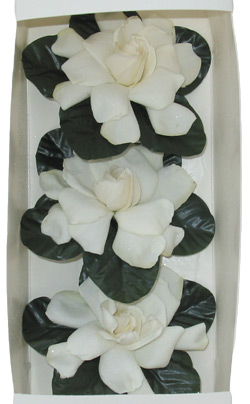
This is how gardenias come packed - 3 blooms, no stems, with a foliage collar (which might be either real foliage or fake), packed in one plastic wrapped box.

This is how stephanotis comes packed - 25 blooms, on inch long stems, in a cellophane box.


We don't get any say in how many blossoms we buy - if you want gardenias you have to buy 3 flowers and 25 for the stephanotis. As a bride, you will find yourself paying for all of the flowers whether or not you use them.

So a good florist will tell you that if you want the groom's boutonniere to made out of stephanotis, that you should try to find a way to use the rest of the flowers, either in your bouquet, or perhaps in corsages. The same holds true with the gardenias.

You'll also note, that unlike almost every other flower, these two don't have stems! Or at least not enough stem to be of much use.

These flowers are always wired and taped to create a usable stem. The beauty of wire and tape (which FYI is how all bridal bouquets were made for years and years) is that you now have a stem that can be bent into any position you need.

The downside of wired and taped stems is the additional labor it takes to make a stem for each bloom. You're going to pay extra for that. It adds a lot of time to the construction of a bridal bouquet, and every step that adds time in labor, also adds to the price.

Gardenias and stephanotis are gorgeous, classic wedding flowers!

Only you can decide - are they worth the price?

Tuesday, August 31, 2010

Send Her Flowers

I know – you’re rolling your eyes right now. You don’t want a chick telling you to buy flowers for your girlfriend or wife. You know about the flower-thing, right?
Then why aren’t you having flowers sent to us more often?!

Just think about when a woman in the office receives flowers – all the other ladies in the office huddle around her to ask her who they’re from, why they were sent, and to ooh and ahh. What can I say – we love the attention and we love when our fellow women swoon over what a nice guy we have.

My husband didn’t send me flowers until almost nine years after we met – sure, he had spoiled me in other ways, but I had never had flowers delivered to me. For my 27th birthday he had flowers sent to my work, and, in typical girly fashion, the women of the office gathered around to “ahh” as I read them the card. I felt really special... to know after all these years that he wanted to do something like that for me meant a lot. He could have run over my dog that morning and the flowers would have made everything all better. (OK, maybe I shouldn’t oversell the value of sending your girlfriend flowers, but it can fix a lot!)

Maybe you’re avoiding this act of kindness because you have ulterior motives – you don’t want to set a precedence so she starts expecting flowers all the time. Well I say "BAH!" That’s a lame excuse to not do something that I am telling you would make your girlfriend’s day.


Sending a bouquet of flowers costs what, $40-50? It’s not an overly-expensive purchase, and you don’t have to make any difficult decisions – just tell the florist to put together their most beautiful arrangement and name your budget. They can always find something to throw together for your other half. Go with a corny sentiment in the card (“thinking of you” or “you’ve been on my mind”).

If you want to really go the extra mile, order her some of our fantastic chocolate truffles – trust me, you’ll get even MORE bonus points because these go beyond flowers. It’s something she can share with her colleagues (making them love you even more).


So do it... right now. Call Carey’s Flowers 413-536-0444 or go on-line to www.careysflowers.com your local florist and send a bouquet to your girl. Do it for no apparent reason other than “you’re thinking of her” (not because I’m telling you to in this article). Also try it on a Monday – it will start her week off on the right foot, and she’ll be showing her appreciation straight through untill the long weekend.

Stop waiting for some momentous occasion (like forgetting her birthday or actually running over her dog) to send her an arrangement of pretty flowers. Heed my corny advice and send her a bouquet. (Then you can send me some flowers to thank me – I love daisies!)
Good luck boys,
Carey's Flower Chick

Monday, June 14, 2010

Flowering Plants Speed Post-surgery Recovery

Flowering Plants Speed Post-surgery Recovery

This post was borrowed from friend and fellow real florist Mark Smith, of Smith’s Flowers, Midland MI. I jut loved it and wanted to share it with all my readers as well.

ScienceDaily (Dec. 30, 2008) — Contact with nature has long been suspected to increase positive feelings, reduce stress, and provide distraction from the pain associated with recovery from surgery. Now, research has confirmed the beneficial effects of plants and flowers for patients recovering from abdominal surgery.


A recent study by Seong-Hyun Park and Richard H. Mattson, researchers from the Department of Horticulture, Recreation and Forestry at Kansas State University, provides strong evidence that contact with plants is directly beneficial to a hospital patient’s health. Using various medical and psychological measurements, the study set out to evaluate if plants in hospital rooms have therapeutic influences.
Studies show that when patients have great stress associated with surgery, they typically experience more severe pain and a slower recovery period. Some of these problems are treated through the use of anesthetics and analgesics, but, if not properly administered, the drugs can have side effects ranging from vomiting and headaches to drug dependency or even fatality. It is therefore beneficial to patients and care providers to develop approaches that improve the overall patient experience but don’t rely on pharmaceuticals.
The study, published in the October 2008 issue of HortTechnology, was conducted on 90 patients recovering from an appendectomy. Patients were randomly assigned to hospital rooms with or without plants during their postoperative recovery periods. Data collected for the study included information on the length of hospitalization, administration of drugs for postoperative pain control, vital signs, ratings of pain intensity, distress, fatigue and anxiety, and the patient’s room satisfaction questionnaire.


Patients with plants in their rooms had significantly fewer intakes of pain medication, more positive physiological responses (lower blood pressure and heart rate), less pain, anxiety, and fatigue, and better overall positive and higher satisfaction with their recovery rooms than their counterparts in the control group without plants in their rooms.
An interesting note to this study—the majority of patients who had plants in their rooms reported that the plants were the most positive qualities of their rooms (93%), whereas patients without plants in their rooms said that watching television was the most favorable aspect of their rooms (91%).


The study suggests that potted plants offer the most benefit, as opposed to cut flowers, because of their longevity. Nursing staff reported that as patients recovered, they began to show interaction with the plants, including watering, pruning, and moving them for a better view or light. A number of studies have also shown that indoor plants make air healthier and provide an optimum indoor environment by increasing humidity, and reducing the quantity of mold spores and airborne germs.
This nonpharmacological approach to recovery is good news for patients, doctors, and insurers alike in terms of cost effectiveness and medical benefits. The study provides strong evidence that contact with plants is directly beneficial to patients’ health, providing meaningful therapeutic contact for patients recovering from painful surgery.

Adapted from materials provided by American Society for Horticultural Science, via EurekAlert!, a service of AAAS.

Friday, February 26, 2010

Every once in a while I find something out there that strikes me and I have to share.

I have heard these stories before but always as "Don't tell anyone"stories as someone in these situations is ALWAYS embarrassed. This one I can share it's a doozie.

When DIY wedding flowers are a DIY- Don’t!
by Shannon on February 26, 2010
I have been having some fun by learning to be creative in a different direction- photography. One of my best friends is an amazing wedding photographer and she is mentoring me. The other day I went with her to a wedding to act as her second shooter. As I was done unloading the cameras, she came over to me and whispered, “Don’t tell them you are a florist.” Why? Because there was a major floral disaster happening in the kitchen of the bride’s home and my friend did not want to lose her second shooter if they enlisted me to help fix the problems.
We have all heard about it and in some cases, seen it. The DIY trend come home to roost. In this wedding’s case it was an Aunt that was a retired “florist”. I do not know what her background was, how long she was in the floral business or how long she was out of it, but this lady should have never undertaken the job of wedding day floral designer.
Some of the atrocities committed on this wedding:
Bridal bouquet had gerbera daisies wired down the stem with the wire sticking out of the bottom was snagging her dress. Brown and wilted callas. Phalaenopsis orchids clumsily wired into the bouquet were wilted and dead. Stem of the bridal bouquet was so large it resembled a “trunk”. Ribbon that was supposed to be ivory was yellow.
Bridesmaids bouquets had wire sticking out of the bottom of the stems. The red ribbon used to wrap the bouquets was not color fast and bled red dye all over their hands.
Flower girls’ headbands, had flowers sticking about 7 inches off the tops of their heads. Head band kept flopping off their heads and covering their eyes. The flower girls were given red rose petals to sprinkle down the aisle of the church. The red rose petals were crushed into the beige carpet leaving awful burgundy stains all over the church’s aisle.
Corsages were cymbidium orchids on the stem with a couple of pieces of sword fern just clamped into an elastic wrist-lette. The metal clamp and mechanics were exposed. The orchids broke off (because nothing was holding them in). Boutonnieres were roses with the blunt cut of the rose stem showing wrapped partially in ribbon secured with a pin that painfully stabbed anyone that hugged the guys.
At the reception each table was decorated differently (all 15 of them) with no sense of continuity (ended up looking like a garage sale). Large arrangements right in the guest’s line of sight. The water in vases was murky and cloudy.
Seeing all of this first hand really brought home how it is the little problems that can really add up and use up time on a day that is already short on time and so charged with emotion.
You can buy a book or watch a You Tube video to learn how to arrange flowers. But what about all of the other little things? Things a special event floral designer with years of experience knows how to avoid.
To spite all my advice I can understand why some brides will still go forward thinking they can design their own wedding flowers. Saving money is usually the deciding factor. I often advise budget brides to make their own centerpieces from items that can be put together well in advance of the wedding (Plants or candles are great choices for easy centerpieces) and have a reputable floral designer put together all of the personal flowers.
Are you unswayed or do you agree? Will you be putting together your own wedding flowers?